Resource allocation
Decision intelligence for institutions
Make complex decisions with a clearer view of the evidence, options, and trade-offs.
Pattern is being built for public and private institutions making high-consequence decisions under uncertainty. It brings evidence, constraints, scenarios, and decision reasoning into one auditable workflow.
Nigeria / Decision surface
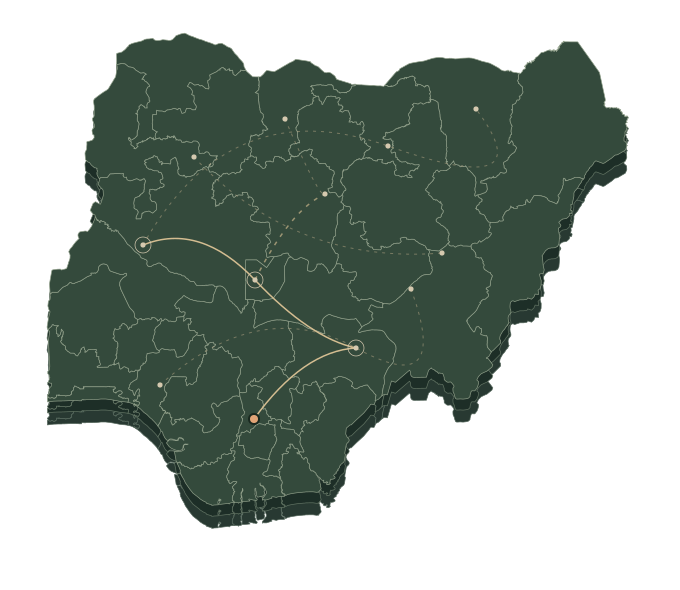 01 / Evidence02 / Scenarios03 / Decision
The standard we are building for
Designed for decisions that need to be explainable, reviewable, and grounded in evidence.
Pattern separates what is observed, assumed, modelled, and decided so institutions can understand not only a conclusion, but the reasoning behind it.
01 / The decision workflow
From fragmented evidence
to an auditable decision
Complex decisions rarely suffer from a complete absence of information. Evidence can be fragmented, assumptions hidden, constraints distributed across systems, and trade-offs difficult to compare.
Pattern is being designed to make that process explicit.
An intended workflow. Illustrations describe the process, not an institutional deployment.
02 / Capabilities
Decision infrastructure,
not another dashboard
Pattern is being developed as a decision layer above fragmented data, analytical tools, models, and institutional knowledge.
Explore all capabilities01
Evidence intelligence
Preserve provenance, conflicting claims, and the limits of what is known.
02Scenario analysis
Compare possible actions under explicit assumptions and uncertainty.
03Option comparison
Examine cost, expected impact, feasibility, and institutional constraints.
04Decision records
Preserve the evidence, reasoning, alternatives, and approvals behind a choice.
05Monitoring and review
Planned: connect expectations, implementation, and observed outcomes.
03 / Decisions in practice
Built around decisions,
not datasets
Pattern starts with the decision an institution needs to make, then works backward to the evidence, constraints, and analysis required to support it.
Risk & response
Which risks require action now, monitoring, or additional evidence?
Portfolio choices
Which portfolio provides the strongest expected outcome within current constraints?
Assumptions & uncertainty
Which assumptions most affect the recommendation?
Accountability
What evidence supported this decision when it was approved?
Learning & adaptation
What changed after implementation?
Examples of intended decision workflows. These are not claims of existing institutional deployment.
04 / Our method
Evidence and models
should not be confused
Pattern is designed around explicit evidence boundaries. Observed evidence, reported claims, assumptions, model-derived outputs, and human judgment should remain distinguishable throughout the decision process.
Read the methodObserved evidenceWhat is established
Reported claimsWhat a source says
AssumptionsWhat is taken as given
Model-derived outputsWhat analysis suggests
Human judgmentWhat people decide
05 / Institutional use
Designed for organizations responsible for consequential choices
Pattern is intended for governments and public agencies, corporations, NGOs, infrastructure operators, and policy and strategy teams working where evidence is incomplete, resources are constrained, and decisions must withstand later scrutiny.
- Public administration
- Infrastructure & resilience
- Security & emergency management
- Investment & resource allocation
- Operations & strategic planning
Potential areas of use.
06 / About Pattern
Built for decisions
that need to hold up later
Pattern is focused on the infrastructure behind institutional judgment: what was known, what was assumed, which alternatives were considered, why one option was selected, and what happened afterward.
Kanmi Obasa - Founder
About PatternStart a conversation
Working on a decision that is difficult to structure, compare, or defend?
Pattern is interested in institutional pilots, domain validation, research collaboration, and decision-workflow partnerships.
Institutional enquiries